
By Jack Rigert
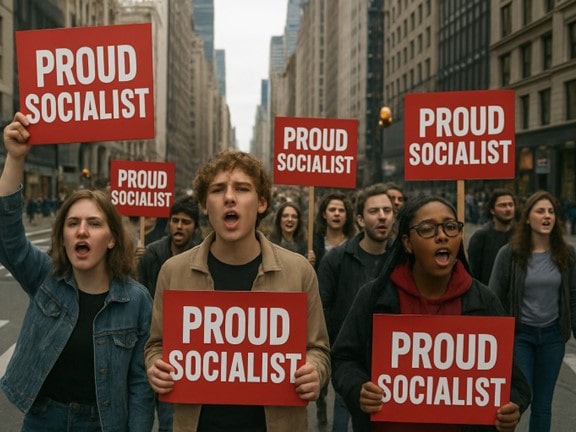
Something remarkable is happening across America’s cities. Young adults—often bright, compassionate, and idealistic—are voting for leaders who openly identify as socialists or even Marxists. Places like New York, Chicago, Minneapolis, and Seattle, once known for their entrepreneurial energy, have embraced movements that have failed everywhere they have been tried.
It is easy, from a distance, to dismiss these young people as misguided or naïve. But that would be a profound mistake. They are responding to something real—something older generations do not always see.
This generation has grown up in a cultural landscape defined by instability. Many never knew a home where mother and father remained united. Many were raised in schools that told them what to think instead of how to think. Most have lived through an economy that treated them not as persons created in the image of God, but as data points, market segments, or labor units. And almost all have inherited a culture that has lost its memory of God.
When the natural anchors of identity—faith, family, tradition, and community—disappear, young people go searching for something that feels solid. They want to belong. They want meaning. They want justice. They want a vision of life bigger than consumption, entertainment, and careerism. And in that search, socialism steps forward as the only ideology that even pretends to care about their hunger for connection and purpose.
This is why the State begins to take on a parental shape in their imagination. It becomes the one institution that appears stable in a world of personal instability. If their families did not protect them, if their schools did not form them, and if their culture did not give them meaning, then perhaps the State will. Socialism makes its entrance not as an economic theory but as a substitute family—a secular orphanage for a generation left unrooted.
The appeal goes deeper still. Young adults today have lived through experiences that shattered their trust in economic and cultural elites. During COVID, they watched small businesses shuttered while massive corporations—allowed to stay open—grew richer. They saw schools closed, churches locked, and public health become a theater of manipulation. They see corporations that champion social causes not out of conviction, but to shield themselves from criticism. They see a market system that often feels impersonal, indifferent, and even predatory.
To them, capitalism—at least in the form they’ve experienced—has not felt like freedom. It has felt like abandonment.
And so they stand before two apparent doors: Door One, where the State owns them; and Door Two, where the Market uses them. These are both distortions, both deformations of the human good. But to a generation raised without moral formation, without deep community, without the transcendent horizon of faith, the “compassionate” promise of socialism feels like the only option that speaks to their wounds.
Yet history offers a sobering truth: socialism has never delivered on its promises. It has produced oppression, poverty, and a mechanized view of the human person everywhere it has taken root. The tragedy is not that young people are drawn to it—the tragedy is that they were never shown the alternative.
Long before our current political moment, the Church offered a vision radically different from both collectivism and unfettered individualism. This vision, articulated by Popes Paul VI, John Paul II, and Benedict XVI, has been described as a “fully Christian humanism.” It is not a vague spirituality or a baptized version of secular activism. It is a profound understanding of the human person as created by God, ordered toward truth, fulfilled in communion, and destined for eternal life.
This Christian humanism shaped the Church’s strong preference for a market economy grounded in moral law and the service of the human person. In Centesimus Annus John Paul II affirmed that “the free market is the most efficient instrument for utilizing resources and effectively responding to needs,” but only when it operates within “a strong juridical framework” that places it at the service of human freedom and recognizes it as a means, not an end. He saw capitalism as capable of serving the good when guided by Christian ethics, the rule of law, and an active civil society—but dangerous when reduced to pure profit-seeking or idolatry of the market.
Paul VI, in Populorum Progressio, taught that authentic human development requires “a complete humanism which is open to the Absolute” and acknowledges man’s supernatural vocation (PP 42). John Paul II warned throughout his writings and speeches that any humanism closed to God ultimately becomes inhuman—an idea he developed in Redemptor Hominis and stated explicitly in his UNESCO address. This is the heart of Catholic Social Teaching. It begins not with structures, but with the human person, body and soul. It sees every political and economic system not as an end in itself but as a framework meant to serve human dignity and the common good.
This Christian humanism is the true Third Way: a path that refuses the suffocating collectivism of socialism and the soul-draining individualism of godless capitalism. It begins by renewing the human heart, restoring marriage and family, rebuilding community, dignifying work, and reorienting society toward the sovereignty of God. It does not require the State to absorb the person, nor the Market to consume him. It simply asks that human beings live according to what they are: creatures made for truth, virtue, love, and communion.
To understand this Third Way, we must recognize the role education has played in the current crisis. For decades, schools have increasingly encouraged children to mistrust their bodies, their families, their histories, and their faith. They were given identity politics instead of identity, ideological scripts instead of truth, and political grievances instead of purpose. And now we wonder why they seek belonging in the machinery of the State.
Those who reject God have understood something Christians have forgotten: whoever shapes the minds of the young shapes the future of a nation. Indoctrination now begins earlier every year—where brightly colored picture books and animated lessons introduce gender ideology into math and literature curricula. Instead of forming free persons anchored in reality, we have created anxious, rootless individuals desperate for someone to tell them who they are.
Behind their political choices lies a spiritual cry.
This is why the renewal of culture cannot begin in the Statehouse or the marketplace. It must begin in the human heart. Political reform cannot save us. Cultural battles cannot save us. Only conversion can. This is where the Christian humanism of the Church becomes not a theory, but a lifeline.
Real change begins with prayer, with families healed and strengthened, with parishes that actually form disciples, with friendships rooted in virtue, with the Sacraments embraced as sources of life rather than cultural ornaments. It begins with young men and women learning again that they are not accidents, nor consumers, nor tools of the State, but beloved children of God.
This is why our initiatives at the John Paul II Renewal Center—like the Claymore Battle Plan and LoveEd, our formation programs—matter so profoundly. They speak directly to the crisis of the young, offering not merely critique, but formation. They provide practices that rebuild the heart: daily prayer, sacramental life, community, mission. They anchor children and young adults in the truth about their identity and their vocation. They give them what socialism cannot give and capitalism cannot teach: a reason to hope.
Because the truth is this: young Americans are not turning to socialism because they are foolish. They are turning to it because they were never shown the narrow gate—never shown a vision of life rooted in Christ, animated by love, ordered toward truth, and sustained by community.
But they deserve better. They deserve the truth about who they are. They deserve the Gospel.
The future will not belong to the powerful institutions of our age—neither the State nor the Market. The future will belong to those who rediscover the narrow gate, who allow Christ to rebuild their hearts, and who in turn rebuild the world. Young adults are searching for a home. The Christian humanism of the Church is that home. It is time we offered it to them with clarity, courage, and love.