
Building The City of God or the City of Man
By Jack Rigert
Lifting His eyes to heaven, Jesus prayed:
“Holy Father, keep them in your name… that they may be one, just as we are one… I do not ask that you take them out of the world, but that you keep them from the Evil One… Consecrate them in the truth. Your word is truth.” (John 17:11, 15-19)
Saint John Paul II offered a three-step blueprint to reclaim the City of God—a culture of life and love rooted in truth—against the rising tide of the City of Man, marked by a culture of death. This plan begins in the human heart, extends to marriage and family, and culminates in socio-political action to transform society for Christ (Cf. Roadmap to Building the Culture of Life, R. Mary Hayden Lemmons)
1. Restoring the Dignity of the Person
“The dividing line between good and evil lies within every single human heart.” – Alexander Solzhenitsyn
The foundation of a culture of life rests on a true understanding of what it means to be human: a person created in truth and love, in the image of God, and called to communion with Him. Evil in the world—whether historical atrocities or today’s moral crises—originates when the light of the Spirit dims in individual hearts. These hearts, unmoored from divine grace, not only commit evil but inspire, coerce, or manipulate others onto paths of destruction.
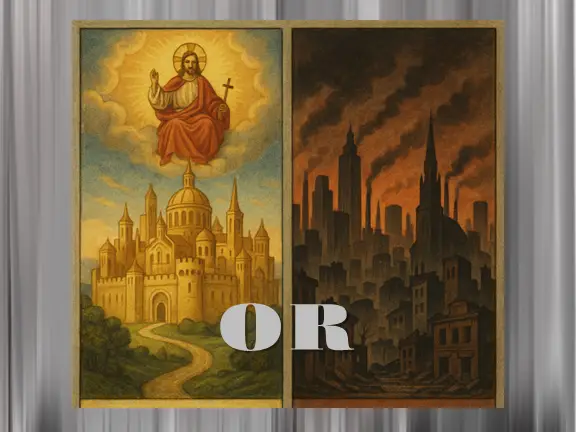
Each person stands, as if before the Tree of the Knowledge of Good and Evil, faced with a fundamental choice: the City of God or the City of Man, Christ or chaos. Without Christ’s divine life, the human person—body and soul—defaults to sin and death, enslaved by what Saint John the Evangelist describes as the “lust of the flesh, the lust of the eyes, and the pride of life” (1 John 2:16). This threefold concupiscence, wielded by the Evil One, wages war on the battlefield of the heart, tempting us to reject God’s love for the fleeting allure of the world.
Yet, God does not abandon us to this struggle. Through repentance and acceptance of Christ’s gift of self—offered in his passion, death, and resurrection—the human person is restored. This redemption infuses us with divine life, the grace that unlocks our potential for true freedom and human flourishing. Jesus Himself reveals the source of this life in His words to Saint Faustina: “Consider My Love in the Blessed Sacrament. Here, I am entirely yours, soul, body, and divinity, as your Bridegroom. You know what love demands: one thing only, reciprocity” (Diary, 1770). In the Eucharist, Christ offers Himself fully, inviting us into an intimate union where His divine life flows into our souls. This sacramental encounter transforms us from “cut flowers,” wilting in sin and death, into branches united to the Vine, the Sacred Heart of Christ, who declares, “I am the vine, you are the branches. He who abides in me, and I in him, he it is that bears much fruit, for apart from me you can do nothing” (John 15:5).
This divine life is not static; it demands action. Restored by grace, we are sent, like Christ, to be a gift of self, loving others in truth and living the truth in love. This mission begins with repentance—a turning away from the culture of death—and grows through a rediscovery of the dignity of every human life, from conception to natural death. The choice for Christ is a daily commitment, fortified by the Eucharist, where we receive the strength to overcome the Evil One and his temptations. As Saint John encourages, “Young men, you are strong, and the word of God abides in you, and you have overcome the Evil One” (1 John 2:14).
2. Restoring Marriage and Family
“The future of humanity passes by way of the family.” – Saint John Paul II
The restored individual becomes a gift to others, diffusing God’s love through marriage, family, and neighborly charity—and, for some, through vowed celibacy as spiritual fathers and mothers. Today, marriage and family face relentless attacks. Saint Lucia of Fatima warned that the decisive battle between Christ and Satan would be over marriage and the family, a prophecy unfolding today.
Abortion, contraception, gender ideologies, and the mutilation of young bodies signal a rejection of God’s design. Divorce, addiction, domestic violence, and economic pressures further fracture families. Saint John Paul II reminded us that, of “the many paths along which men and women walk, the family is the first and most important. It is a path common to all, yet one that is particular, unique and unrepeatable, just as every individual is unrepeatable; it is a path from which men and women cannot withdraw. Indeed, a person normally comes into the world within a family and can be said to owe to the family the very fact of his existing as an individual. When he has no family, the person coming into the world develops an anguished sense of pain and loss, one that will subsequently burden his whole life” (Letter to Families, Pope John Paul II, 2.).
“It is important to discover anew the many signs of the Church’s love and concern for the family, a love and concern expressed from the very beginning of Christianity, when the meaningful term ‘domestic church’ was applied to the family. For the family has its origin in that same love with which the Creator embraces the created world as was expressed” (LF, 2,3) “in the beginning”, in the first chapter of Genesis 26-28, “Let us make man in our image, after our likeness. God created man in his image, in the divine image he created him; male and female he created them. God blessed them, saying to them: ‘Be fertile and multiply; fill the earth and subdue it”.
In many ways the modern world has rejected God and lives in ‘disconnection’ from His Divine Plan ‘in the beginning.’ There are many families in difficulty or danger, lacking confidence or experiencing division, or in situations that can be described as “irregular”. Already in 1994 John Paul II wrote in his Letter to Families, “Unfortunately various programmes backed by very powerful resources nowadays seem to aim at the breakdown of the family. At times it appears that concerted efforts are being made to present as “normal” and attractive, and even to glamorize, situations which are in fact “irregular”. Indeed, they contradict “the truth and love” which should inspire and guide relationships between men and women, thus causing tensions and divisions in families, with grave consequences particularly for children. The moral conscience becomes darkened; what is true, and good and beautiful is deformed; and freedom is replaced by what is actually enslavement” (LF, 5).
3. Socio-Political Activism: Reclaiming Culture for Christ
“When God is forgotten, the creature itself grows unintelligible” (Gaudium et specs, 36)
While the culture of death must first be expelled from our hearts and our homes, it must also be driven from our laws and public policies.
Jesus words, “You too go into my vineyard” never fails to resound in the course of history: it is addressed to every person who comes into this world (Christifideles Laici, John Paul II No. 2).
The Church always calls us as the laity, men and women, to go on mission and bring the light of faith into a dark world.
In Evangelium Vitae John Paul II analyzes various threats to human life. Taking priority are the threats to life at its beginning and end, through such means as abortifacients, abortions, infanticide, and euthanasia. John Paul II takes care to note that these attacks on human life are not random but are rather “scientifically and systematically programmed threats…involving even international institutions engaged in encouraging and carrying out actual campaigns to make contraception, sterilization, and abortion widely available. In this anti-life campaign the mass media plays an important role. These systematic attacks on life are so dire as to constitute a culture of death representing “a direct threat to the entire culture of human rights…capable in the end of jeopardizing the very meaning of democratic coexistence.” (EV, JPII, 18.5; Roadmap to Building the Culture of Life, R. Mary Hayden Lemmons)
This is because there is the tendency, ever more widely shared, to interpret the above crimes against life as legitimate expressions of individual freedom, to be acknowledged and protected as actual rights. John Paul II explains that when rights are no longer “founded on the inviolable dignity of the person but is made subject to the will of the stronger part…democracy, contrary to its own principles, effectively moves towards a form of totalitarianism.” (EV 20; Roadmap, Lemmons)
“Democracy cannot be idolized to the point of making it a substitute for morality or a panacea for immorality… The value of democracy stands or falls with the values which it embodies and promotes” (Evangelium Vitae, 70).
Rejection of objective standards of good and evil confuses conscience, facilitates the successful manipulation of mass media and favors acquiescing to the will of the majority. This acquiescence is intolerant of those who challenge the emergent consensus (EV, 24.1, 70.1).
The American Founding Fathers understood this principle. As John Adams said: “Our Constitution was made only for a moral and religious people. It is wholly inadequate to the government of any other.”
The Church calls all the lay faithful to actively engage in the renewal of society and the transformation of culture. The Catechism teaches: “It is necessary that all participate, each according to his position and role, in promoting the common good. This obligation is inherent in the dignity of the human person. As far as possible, citizens should take an active part in public life” (CCC 1913–1915).
Conclusion: Christ or Chaos, Life or Death
“I have set before you life and death, blessing and curse; therefore, choose life, that you and your descendants may live” (Deuteronomy 30:19).
This is the great choice that lies before every person, every family, every society, and every generation:
The Gospel of life is for all humanity. A society that tolerates the devaluation of life lacks the foundation for justice, peace, or true democracy. By restoring the dignity of the person, defending marriage and family, and engaging in principled activism, we build the City of God—a culture where love and truth reign.
The future of humanity depends on it.